Why it is difficult
Start with one fact: every distributor owns a product catalogue built in its own way. Each describes and promotes the same products using its own marketing labels, custom attributes and ordering, while rarely exposing identifiers on published product pages. Two records for the same product may therefore share no words at all. The most common mistake is assuming product codes are enough. A website's SKU is not a universal identifier; it is an internal code specific to that distributor, so two websites selling the same product assign it different SKUs. EAN/GTIN is global but often missing from catalogues or published pages. Even when present, it is not absolute proof: the same product may carry several EANs on the market, one per country, or separate EANs issued by the manufacturer to segment distribution channels.
Add variants — the same model in twelve sizes and three colours — packaging differences such as one unit, a pack of three or a case, private labels, commercial names rewritten by every retailer and incomplete records on both sides. String comparison is not enough: you must understand the characteristics.
Signals of a reliable match
| Signal | What it proves | The pitfall |
|---|---|---|
| SKU | Nothing across catalogues: it is an internal code belonging to each distributor. | Two websites selling the same product assign it two different SKUs. |
| EAN / GTIN | Strong evidence when it agrees — a global identifier, not an internal code. | The same product often has several EANs, by country or distribution channel. A different EAN proves nothing either way. |
| Brand + MPN | The only genuine unique product identifier. | An MPN alone can collide across manufacturers, and the pair is rarely exposed on published pages. |
| Technical characteristics | Distinguish close candidates; the only possible basis for similar matching. | Inconsistent marketing labels and units must be normalised before comparison. |
| Visual verification | The final judge — images settle the question. | A “no match” verdict without comparing images has no value. |
Serious matching combines several signals and retains the evidence: which record was selected, what data was read from it and why the verdict was reached. A match without justification cannot be audited and therefore cannot support consequential decisions.
What if the customer's data is unavailable?
Experience shows that even established e-commerce businesses do not always have their own data readily available. Legacy platforms carry years of complexity, and the teams that use the data — for price intelligence, for example — often do not control the catalogues themselves. Waiting for a clean information-system export can add months of internal work.
In practice, matching therefore often begins with research — including from the customer's own public, up-to-date website. Those records are then completed from the web to recover the attributes, descriptions and images needed. This reconstructed catalogue makes high-quality similar matching, and even exact matching, possible. Matching is not an isolated operation; it is the final link in a chain that starts with sourcing and enrichment.
Exact or similar: two different problems
Exact matching answers “is this exactly the same product?”. Similar matching (like-for-like) answers “is this product an acceptable equivalent?”. The second question only makes sense when equivalence criteria are explicit.
Why does similar matching exist? Because exact matching has a structural blind spot: private labels and exclusives. By definition, a product only you sell has no identical record at a competitor — yet this is where a benchmark matters most because you set the price. Your green lamp is exclusive; the competitor sells a comparable blue lamp. Exact matching will never connect them, but that blue lamp reveals whether the market is on promotion and whether your price should move. Similar matching creates that benchmark: a defensible equivalent used as an indicator of price and positioning.
A robust definition of equivalence distinguishes two types of criteria. Mandatory criteria are eliminatory, beginning with product type: a mixer tap does not replace a simple tap, regardless of its other qualities. Useful criteria only rank candidates that are already valid. Tolerances are stated explicitly — “dimensions ±10%” — and brand tier must be respected: premium national brands, mid-market challengers, generics and private labels are not freely interchangeable. One tier of difference is flagged; two tiers — proposing a generic against a premium brand — are forbidden even if every characteristic agrees. When a brand's position is uncertain, treat it as mid-market rather than incorrectly downgrading it. Brand tier applies only to equivalence: an exact match remains valid whatever the tier, because it is the same product.
// real example · similar matching
Comparable, without claiming they are identical
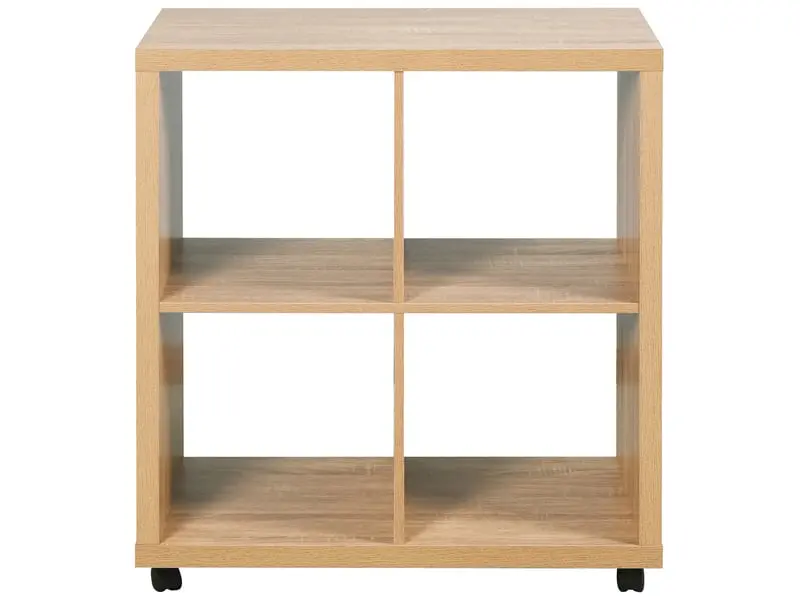
Conforama France
ALVIN bookcase
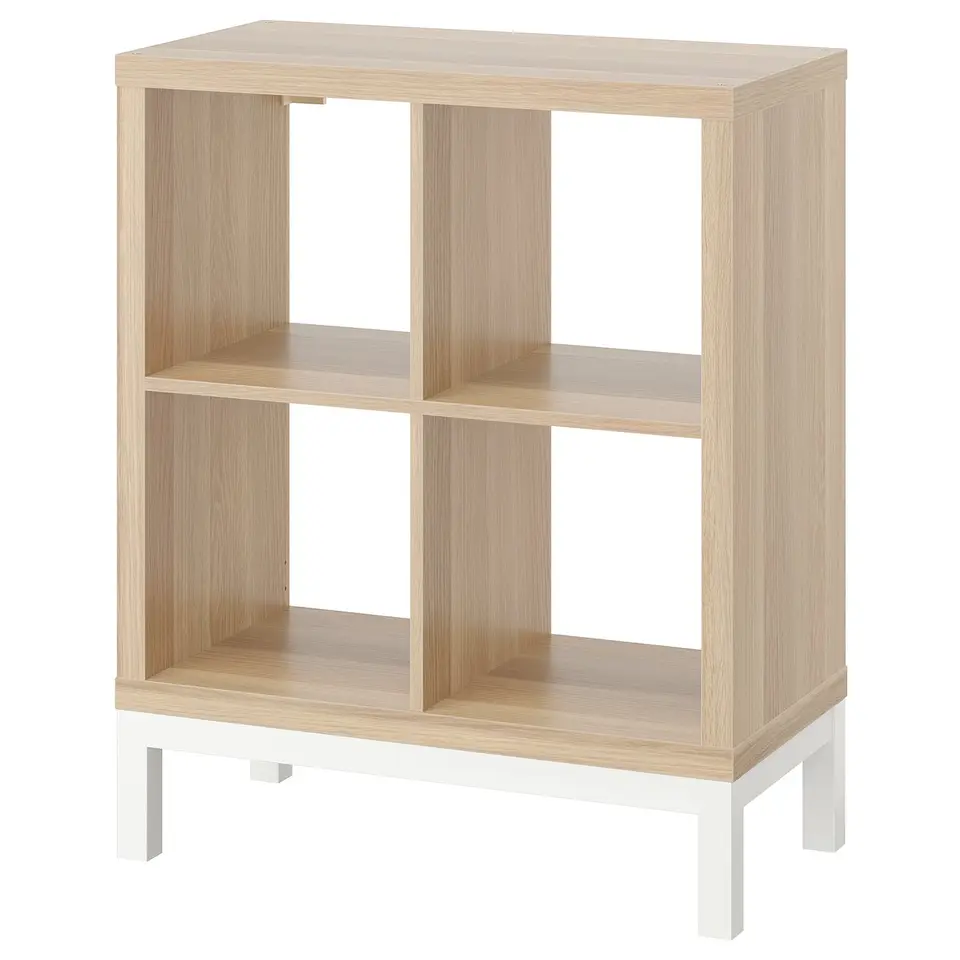
IKEA France
KALLAX shelving unit with underframe
-
01 Structure
4 open compartments
✓4 open compartments
-
02 Dimensions
81.2 × 39 × 87.4 cm
±10%77 × 39 × 94 cm
-
03 Material
Panels + paper finish
✓Panels + paper finish
Visible difference retained
Castors and Sonoma oak effect on one side; white underframe and white-stained oak effect on the other.
SIMILAR not identical
Where do equivalence criteria come from?
Two approaches coexist. When a company already has an equivalence policy — category-specific criteria inherited from its domain expertise — the right approach is to connect those rules as they stand. Link each product category to its rule once, and a correction propagates across the entire category. A few hundred written, revisable decisions are always better than tens of thousands of invisible ones.
AI agents also enable the opposite approach: defining criteria product by product. For a given item, the agent reads the record, analyses the image, identifies the product type and the characteristics that matter for that precise product, then searches for an equivalent on that basis. No prewritten rule library is required: criteria are derived at match time and recorded with the verdict so they can be challenged. This makes similar matching practical across heterogeneous ranges where writing rules manually for every category would never be finished.
Where should candidates be found?
Aggregators provide a useful shortcut. Google Shopping and price comparison engines already group offers around the same product. These are excellent matching clues, provided they are treated as candidates to verify on the target website's product page, never as final verdicts.
Crawling itself has changed with agents. In the past, collecting the information required a crawler for each website — an investment for every competitor that broke with each redesign. Today, an agent navigates on its own: it discovers where a product is sold, opens the page and checks the evidence directly.
This discovery enables a new service. Until now, companies had to define their competitor list before launching a price benchmark. They can now ask the reverse question — “where are my products sold, and at what price?” — and let agents map the market.
Multi-angle search
on-site · web · image · aggregators
Filtered candidates
category present · brand stocked · use segment
Visual verification
images from both records compared
Traceable verdict
proven match — or justified rejection
Brand coverage: the forgotten filter
Searching for a product on a website that does not stock its brand is pointless and creates false positives. Before matching, establish coverage: which brands from the source catalogue does the target website actually sell? Matching brand names is a small matching problem in itself: legal suffixes to clean up (SAS, GmbH, Ltd), accents and spelling variants. Fuzzy matching with a high similarity threshold resolves them. The list of uncovered brands is also a useful deliverable in its own right.
Common pitfalls
- Variants — if another variant of the same model has already been matched on the website, the product page is often the same. Reuse that work instead of starting from scratch. Better still, the distributor's page often lists every variant through its size and colour selector. Using it finds the right variant, immediately proposes alternatives and confirms your own parent/variant grouping.
- Packaging — a pack containing different sizes may still be a valid match; rejecting it mechanically loses real correspondences.
- Price gaps — differences between websites are normal and do not invalidate a match. Classifying them as small, notable or suspicious does, however, reveal probable errors.
- Duplicates — when two source products point to the same target page, one is wrong. Detect and resolve the case explicitly rather than ignoring it. One principle helps: two references that coexist in a catalogue are distinct products by construction. A difference must exist; find it.
- Use segment — adult and child, professional and consumer, indoor and outdoor: even when physically similar, these are not substitutable types. A children's mattress is never equivalent to an adult mattress, whatever its characteristics.
- The target's vocabulary — searching for an equivalent using the marketing language of your own catalogue only returns products marketed the same way. Search in the language of the target website: function and discriminating characteristics, never your own commercial name.
Verdict discipline
A few rules of discipline separate industrial matching from approximate matching. When in doubt, do not match: rigour matters more than match rate. Never rationalise a discrepancy — “rolled steel and zamak may be close”, or “1 L and 1.1 L are almost the same”. A divergent attribute is observed, not negotiated. Intermediate verdicts such as “maybe” or “not applicable” are forbidden. Every criterion complies or does not; a criterion that cannot be compared because data is missing counts as non-compliant.
Price is never an eliminatory criterion — differences between websites are normal — but it is an excellent warning signal. A gap of more than double should be explained by a differentiating characteristic such as capacity, energy class or technology. If it is not, this is probably the wrong product, often the wrong variant of the right model — the source of most false “exact” matches.
How to evaluate a matching service
Four questions separate serious work from the rest. Is every match proven with the product-page URL, extracted data and a justified verdict? Are “no match” results explained or simply silent? Are equivalence rules written and revisable or buried inside a model? Is there quality control — classified price gaps, challenged duplicates and a second look at edge cases? An overall confidence score replaces none of these answers.
What product matching is used for
The main use case is pricing. A price-intelligence operation can only manage what has been matched: every additional point in match rate adds products to which pricing rules can be applied — align, differentiate or react to promotions. Increasing exact and similar match rates expands the manageable share of the catalogue. That is where price optimisation happens.
Other uses include positioning private labels and exclusives against competing equivalents, substitution when a product disappears and tenders that require defensible equivalents.
Related topics: product matching · parent/variant · product data enrichment · KaraK for price intelligence
Reference sources for product identifiers
GS1 defines the respective roles of GTIN, EAN and barcodes. Google Merchant also documents the GTIN types expected to identify products in merchant feeds. These standards provide strong signals; the production experience described on this page explains why they are not always enough to match real-world catalogues.
- GS1 — differences between GTIN, barcode, EAN and UPC;
- Google Merchant Center — finding and using a GTIN.
Sources accessed 15 July 2026